Showing posts with label Barbara Wright. Show all posts

Monday, May 21, 2012

Episodes: An Unearthly Child - An Unearthly Child

Hey, it's a new series! Not Doctor Who, that's been around for almost fifty years. No, I'm talking about this series, in my blog - I'm going to take a close look at every single episode of Doctor Who, one by one, from the very beginning. I'm calling it "Episodes", because in a fit of dullness I called my series on the companions "Companions" and now I feel obliged to continue the theme. Given how often I update my blog and how many episodes there have been, I expect none of us will live to see the finish. Let's try anyway!

One note before we begin - I never intended this blog to be a review blog. Even when I thoroughly dissect/mock/insult a comic book, I don't consider it a real review - I'm just trying to be funny, or maybe highlight something I find interesting. If you want reviews, there are plenty of places on the internet to look, most of which will do it far better than I ever could. (And - unbiased plug -  if you want some amazing analysis, particularly of the episodes commonly held to be the "worst of Doctor Who" (as if there could be such a thing), check out Philip Sandifer's marvelous Tardis Eruditorum. In fact, don't click that link, click this one, start at the beginning, and work your way forward. Go now. My stupid dirty jokes will still be here when you get back.)

All this is meant to be is a recap of the episodes paired with my response to and thoughts about them, as I watch them. I've seen them all before, I'll see them all again. And no matter how much I mock, I truly believe Doctor Who is the best show on television. Ever. If you disagree, you're wrong and something in your brain is broken. Ok, let's go!

An Unearthly Child
An Unearthly Child


I'm not sure the original arrangement of the Doctor Who theme song has ever been improved upon. It's eerie and catchy and has a driving beat and it sounds like nothing else but itself. It was composed by Ron Grainer but much of the credit really has to go to arranger Delia Derbyshire, who was responsible for the electronic ethereal sound. I enjoy the modern series' dramatic orchestral arrangements too, but given a choice, I'll stick with the original.


The titles fade to show us a policeman - the first ever actor to appear in Doctor Who, and he doesn't even appear in the credits. His name's Reg Cranfield - you're an important part of history, Reg Cranfield, and we salute you! Whoever the hell you are.

P.C. Reg is on patrol this dark and foggy night. The theme music continues to play as he checks the lock on a gate - painted on the gate is: "I. M. Foreman, Scrap Merchant, 76 Totter's Lane". All's well, and he totters off to take his place in the footnotes of sci-fi history. But the camera moves forward as the gates open, revealing a junkyard full of...well, junk. The theme music finally fades - it's really been going on for an awful long time now - as the camera pans to a police box, which I assume the kids of 1963 would have recognized. (Maybe?) Besides the incongruity of a police box in a junkyard, there's also the strange electronic hum that the music has faded into. It's pretty cool - director Waris Hussein is doing a very good job of letting us know that something very strange is going on in this junkyard, without a single word of dialogue.


In the olden days of Doctor Who, every episode had its own title, just like...just like today, actually. But for most of the show's existence, stories were divided into multiple parts with one umbrella title. Since the first few seasons had no umbrella titles for multi-part stories, there's some disagreement as to what some of those titles should be. I'm going with the ones I like best, because it's my blog. This policy will occasionally lead to me looking like my title is stuck on repeat, as with this first installment, in which I'm looking at the episode "An Unearthly Child", the first part of the serial An Unearthly Child.

The camera zooms in on the instructions posted on the door (Pull to open! Neil Gaiman will make a joke about this that doesn't quite work in about fifty years.) then dissolves to...


Coal Hill School, where football and athletics are different, I guess? Is that a British thing? Maybe the house news explains it. We hear a teacher - who we'll come to know and worship as Barbara Wright - say the very first line of dialogue ever uttered in Doctor Who - "Wait in here please, Susan. I won't be long." Say it a few times. Roll it around in your mouth. Taste the history!

But before we learn who this woman is, who Susan is, why she's waiting and what won't take long, we get a quick glimpse of some Coal Hill students, one of whom should have been nominated for a BAFTA for Best Performance by an Extra.


Two girls are walking down the corridor talking, looking at a piece of paper (presumably a graded assignment or a report card), and a boy comes up between them and pretends to join in on their conversation. He says, "Oh, yeah," in a voice dripping with mockery, and then walks away, leaving the girls shaking their heads in annoyance. It all takes about two seconds and there's seemingly no point to it. I don't know if Hussein or writer Anthony Coburn included this scene, but it's brilliant. Apart from the boy's joke being so dumb it's kind of funny, it sets up the utter normality of the Coal Hill School. It is filled with perfectly normal teenage boys and girls, worrying about their grades and teasing/flirting with each other. The show has established a normal world, with a normal school and normal teenagers, which sets the viewers up for the stark contrast with normality that's coming up. (In this episode, and for the next fifty years.)


Meanwhile, Barbara has ducked into another classroom to talk with her colleague, science teacher Ian Chesterton. Barbara teaches history, and is having a problem with one of her students, fifteen-year-old Susan Foreman. Both teachers have noticed that Susan is brilliant - Ian thinks she's holding back on revealing just how much she knows so as not to embarrass him. Barbara suggested that Susan specialize, and offered to work with her at home - Susan said that would be impossible, as her grandfather disliked strangers. (We will soon discover this to be a massive understatement.) Barbara, suspicious, got Susan's home address from the school, but when she arrived, all she found was a junkyard. Barbara suggests a stakeout - they'll drive to the junkyard, hide, and when Susan arrives they'll see where she goes and follow her. Ian agrees, because that doesn't sound as insane and possibly criminal to him as it did to you when you just read that. 


Meanwhile, back in Barbara's classroom, Susan is listening to some groovy rock and roll on her transistor radio and anachronistically dancing the hand choreography from Spring Awakening. The two teachers enter, and Ian offers Susan a ride home. Susan declines, dismissing Barbara's warning about fog and saying she likes to walk through the dark because "it's mysterious". Perhaps she doesn't know Hot Topic hasn't been established yet and she's hoping to get some shopping in on the way home.


As the teachers leave, Susan flips through the book on the French Revolution that Barbara has lent her, muttering, "That's not right!" The book has no text or pictures on the front or back covers besides the magnificently generic title, The French Revolution. I'm not sure if Susan has found a mistake, or she's just dismayed at the quality of textbook the Coal Hill School is providing for its students. (Maybe Barbara self-published?)


With Susan's book bit having given them enough time to run over to the next set (the show was filmed "as live" in those days), Ian and Barbara pull up in front of the junkyard at 76 Totter's Lane. Although Barbara insists they're there for Susan's own good, Ian suggests it's more because they're both just curious. They have a little flashback sequence, reminiscing about the various ways Susan has freaked them the hell out.


The first takes place in Barbara's history class, and it's my favorite of these three sequences because it shows Barbara not even making a token attempt to stop the students from openly mocking Susan for being different. She is seated dead center in the room while all the students laugh at her and Barbara scolds her angrily for not knowing that Britain isn't on a decimal system of currency. That open cruelty and lack of sympathy is thoroughly unlike Barbara, but I suppose it's understandable that she'd have a hard time keeping control of her class while reading in her lines off-screen from the junkyard set.

The second sequence is in Ian's class, as she argues with him that the experiment he's having them do is pointless and obvious. I only bring it up because Carol Ann Ford, who plays Susan, is marvelous in this scene, as she is throughout most of these early episodes. It's a shame how much the writers will let her down in a few stories' time - but I'm getting ahead of myself...

The teachers finish reminiscing. I kept waiting for one of them to say, "That child...she's so...unearthly," but they didn't, because Anthony Coburn is a better writer than I am. Susan arrives and enters the junkyard gate, sneaking a glance over her shoulder in a completely non-suspicious manner. Ian suggests that maybe she's just meeting a boy, and Barbara hopes she is, because "it would be so wonderfully normal." I'm wondering what kind of adolescence Barbara had, that she considers meeting a date in an abandoned junkyard normal.

The teachers follow Susan in, but there's no sign of her. After calling out for her with no response, Barbara stumbles upon the police box from the start of the episode.


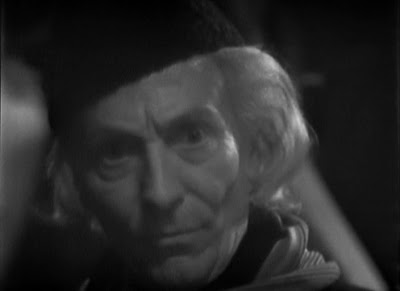
They hear that same electronic hum, and Ian puts his hand on the box, feeling a vibration. (That's what she said.) They suddenly hear a loud deep cough coming from outside. It's clearly coming from a man, but Barbara still asks, "Is that her?" She gets smarter, I swear. The duo hide, and the gate opens, giving us - nearly twelve minutes into the episode - our first look at the Doctor.
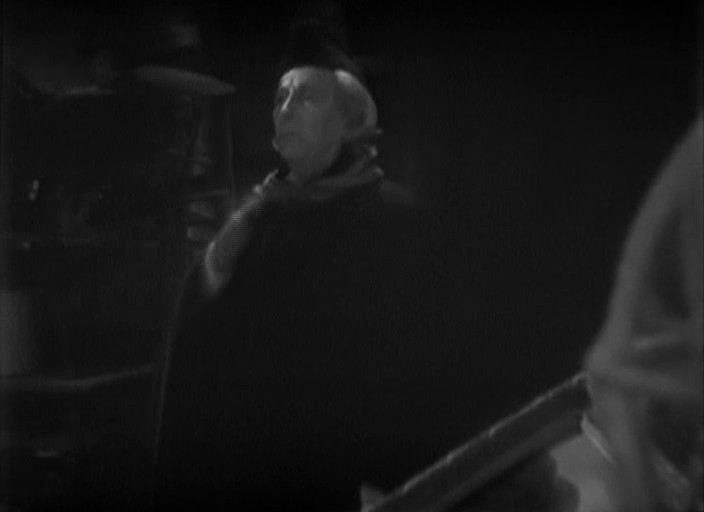

He moves towards the police box and begins to open it, when Susan calls out to him from inside. Barbara calls out, "It's Susan!" and the Doctor spots them. The teachers come forward, and explain that they're looking for Susan Foreman. 


The Doctor is completely dismissive of them, and the pair quickly become convinced that something criminal is afoot, that the old man has Susan locked up in the tiny police box. William Hartnell, as the Doctor, is wonderfully sinister in this scene - in retrospect, we can see that he's trying to get rid of the teachers so he can slip into the TARDIS and get away, but watching this for the first time it's perfectly plausible that this creepy old man has a teenage girl locked up in a box.


Just look at him - madman with a box, indeed! Just as Ian is about to go and fetch a policeman, the police box door opens slightly and Susan calls out again from inside. Ian holds the Doctor off while Barbara runs through the doors.


Here's another first in an episode that is, quite naturally, full of them - the first reaction to the inside of the TARDIS, and the most believable. She doesn't say a word, she doesn't blurt out anything about it being bigger on the inside. She's completely silent, staring in incomprehension while her mind tries to take in the impossibility of what she's seeing.


Ian charges in after, and doesn't do any better. The Doctor - who is finally introduced as Susan's grandfather - spends a few minutes trying to answer the teachers' questions about where exactly they are, but nothing he says makes any sense to them.


Susan explains that they're in her grandfather's ship, called the TARDIS - a name she coined from the initials Time And Relative Dimension In Space - and that in it they can go anywhere in time and space. Barbara and Ian still don't get it, and Susan's perplexed by their lack of comprehension. The Doctor, who's been hilariously and dickishly condescending throughout this entire scene, offers a metaphor to Susan as an example: "Now, now, don't get exasperated, Susan. Remember the Red Indian. When he saw the first steam train, his savage mind thought it an illusion too." Oh 1963, you lovable old racist!


Susan and her grandfather reveal that they are from another time and another world, and that they are exiled, "wanderers in the fourth dimension", unable to return home. Barbara and Ian don't believe a word of it. Susan tries to convince the increasingly sinister Doctor that the teachers are no threat to them, but he's made up his mind - he can't let them leave.


The teachers run for the doors, but they won't open. The Doctor laughs mockingly as Ian scrambles around the control panel, trying to find the one that will open the doors.
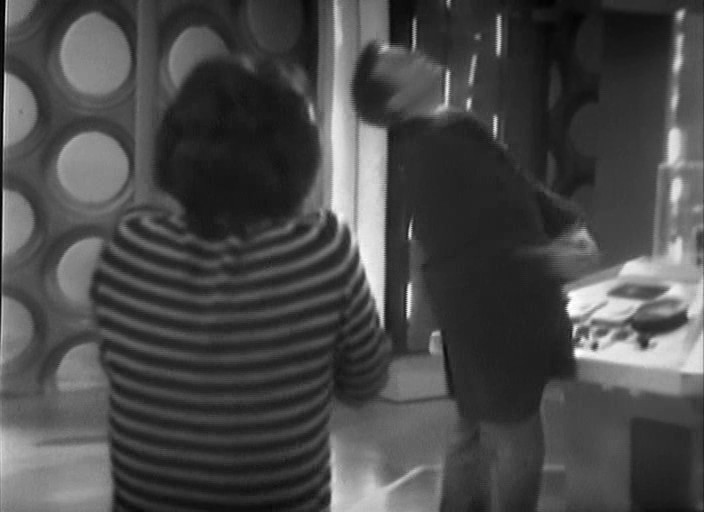

The old man goads Ian into trying a switch, which promptly electrocutes him. The Doctor's a bad guy in this episode - have you picked up on that yet? Ian and Barbara are the stars of this show; our demi-title character is their antagonist.

Susan begs the Doctor to let the teachers go, but he insists that if they do, the Doctor and Susan will have to leave as well to avoid being hounded by the authorities when Ian and Barbara tell the world. Susan declares she won't leave the twentieth century, that she's never been happier, and that she'll stay behind if the Doctor leaves. Surprisingly, her grandfather quickly agrees, and moves to the console to open the doors. Of course, he's lying, and instead he sets the ship in flight.

The Doctor's decision to kidnap the school teachers has come in for a lot of criticism as irrational - why not just let them go, and take off with Susan? But Susan has just insisted she'll stay behind if he leaves - if he opens the doors to let the teachers go, she'll run out right behind them and he may never see her again. What I find more interesting are the choices he offered Susan before she gave her ultimatum - he lets them go and he and Susan leave Earth, or he doesn't let them go and he and Susan stay. But suppose Susan had agreed to this, and wanted to stay? Did he plan on keeping Ian and Barbara prisoner in the TARDIS forever? Throughout this scene Susan seems absolutely terrified on behalf of these teachers she's grown so fond of, but the idea that her grandfather would kidnap them doesn't occur to her, so...what's she afraid of? Is the Doctor willing to murder Ian and Barbara to keep his granddaughter safe? Given how much of a threat the show is painting the Doctor as, I think that seems likely. It's only when he sees that Susan is willing to leave him forever to stay with them that he chooses what he sees as the only remaining option - take them all away.


Susan tries to wrestle him away from the console, but he fights her off. The take-off is presented far more dramatically than it will be in later episodes - Ian and Barbara pass out, London recedes on the monitor, and that weird camera effect from the opening credits superimposes itself over everybody's faces. I suppose it would have gotten pretty tiresome to do this every time the TARDIS takes off for the next fifty years, but it certainly does establish the ship's flight as a very big deal.


In the quiet moment after their landing, we see, just for a second, a look on the Doctor's face that might possibly be regret. William Hartnell is a good actor. Forget about the fluffed lines that he becomes unfairly known for. He's very good, and that's all I'll say about that. (Not that I'm not going to make fun of the fluffed lines once they start happening.)

Outside, we see that the ship has landed on a barren landscape, and a sinister shadow appears, watching. Next Episode - The Cave of Skulls!


Sneak preview - it is not nearly as exciting as it sounds.

Saturday, February 4, 2012

The Doctor in the Dell

In 1965, less than two years after Doctor Who aired its first episode, the good Doctor made his big screen debut in Dr. Who and the Daleks. The film starred Peter Cushing as eccentric scientist Doctor Who, who lived in a cozy little nondescript house in London with his granddaughters Susan and Barbara. Doctor Who built "Tardis", a time and space machine, and kept it in his back garden. While showing his new invention off to Barbara's boyfriend Ian, the quartet were accidentally whisked off to the planet Skaro to have an exciting technicolor adventure with the Daleks.

Dr. Who and the Daleks is based on the second television story, The Daleks, which introduced the titular monsters. I hated this movie as a kid - it wasn't the REAL Doctor, after all. For one thing, he wasn't called "The Doctor" in it; people actually addressed him as "Doctor Who" (making his granddaughters Susan Who and Barbara Who, presumably).  He was human, he lived in a house, he had two annoying granddaughters instead of just one...to the twelve-year-old me, these differences made the movie just plain wrong, which meant it couldn't possibly be worth my time. But watching the movie again as an adult with a slightly broader perspective on what counts as "real" Doctor Who, I was surprised to find that, taking it for what it is - a children's adventure story - it's actually quite good. 

In 1966, tying in with the film's release in America, Dell Comics released an adaptation. While the movie moves at a breakneck pace, condensing seven television episodes into about eighty minutes, the comic moves at a shatter-every-bone-in-your-body pace, condensing those eighty minutes into just one issue. Let's fasten our seatbelts and take a look!


"Everywhere! Watching and waiting...the incredible robots, the Daleks!!" If you read that and found yourself thinking, "The Daleks aren't robots! They're living creatures inside armored travel machines!", then you are a colossal nerd and I like you very, very much. 


The movie throws a whole five minutes away on introductions, but the comic cuts right to the chase, telling us pretty much everything we need to know about the characters and the situation on the very first page. And yes, that's the TARDIS - sorry, just TARDIS, no definite article. (Or maybe it's Tardis? Hard to tell, lower case letters aren't allowed in comics.) It's still a police box in the movie, but the comic glosses that over - it was intended for American readers, who presumably wouldn't know what a police box was. (I've been watching Doctor Who for thirty years and I still only have a vague idea what they were actually used for.)


Here is the first of many full-panel close-ups of Doctor Who's face. The artist is Dick Giordano, a comics legend, and he seems to be justifiably proud of how well he's captured the likeness of actor Peter Cushing. The three other characters bear a passing resemblance to the original actors, but I doubt many American readers were too distressed by an off-model Roberta Tovey.

Sorry, Grandpa Who, I interrupted you. Do go on...


Oh, I see. It's dissolves everyone in it. So, you've not so much built a time machine as you have a disintegration chamber. This is a pretty standard explanation for teleportation in science-fiction, and it's always bothered me. Isn't that just killing somebody and then making a double of them in another location? I don't care if that other person is identical to me and has all my memories, the original me is still a pile of ash in Doctor Who's back garden.

Having your time-space machine operated by a giant red "start" button is just asking for trouble, and sure enough, clumsy but lovable Ian trips and smashes his head on it. Since Doctor Who didn't have a chance to set the controls, he announces that they could be anywhere in time and space! Given how much of space is an empty void you'd think they'd just be floating aimlessly, but no, they manage to find themselves on an inhabited planet capable of supporting their kind of life. What luck! But Ian doesn't think they've moved at all, and tries to open the doors, with no success.


I'm not really sure about the point of these panels. The doors are stuck, which Ian inexplicably finds inexplicable, so he uses a screwdriver to pry them open. This doesn't happen in the movie - Ian opens the doors just fine. Given how much story is crammed into every panel in this comic, I'm having a hard time figuring out why the uncredited writer decided to add in this seemingly meaningless bit of business. I don't have a joke. I'm honestly hoping someone can tell me the point of this.


And here's an even more off-model representation of our cast, based on the publicity shot used on the cover. Yes, TARDIS is green throughout the comic. No, it's blue in the movie, just like on the show. The St. John's Ambulance sticker is a nice touch, though, don't you think?

Doctor Who discovers that everything in the jungle is petrified, and there's no sign of life - except possibly for...


Whee! Must be a low gravity planet with the way they all seem to be bouncing and floating above the surface of the planet! Oh, it's not? Normal gravity? Ok then. Everybody is down for investigating the city except killjoy Ian, but it's the 1960s and he's the young white male so they all listen to him and head back. Except for Susan, who wanders off on her own.


Stranger danger! The quartet flee from the terrifying hand to the safety of TARDIS. Doctor Who is skeptical about the possibility of human life existing on this planet, but then there's an unexpected knock at TARDIS' door!


But the mysterious granddaughter groper has ding-dong-ditched, and the scanner shows nothing. We're on page 7 now, and Barbara finally gets a full line of dialogue, asking her grandfather to please take them home. All she's said up until now was "Ian!" when her boyfriend tripped and hit his head on the controls. Barbara is not exactly showcased in this comic, is what I'm saying, and she didn't have all that much more to do in the movie. In the TV series Barbara is one of the greatest companions the show has ever had. In the film, she's mostly a plot device to get Ian into the story, and probably could have been written out entirely if the producers didn't think they needed a pretty girl in there somewhere.

Doctor Who agrees to set the controls for home, but there's a problem...


Oh no, the fluid link is empty and all the mercury has run out! Now they have no choice but to explore the city in the hope of finding more mercury. 


THAT'S what the knock was - a drug delivery! Because Doctor Who is not me cautious, he does not immediately sample some of the drugs to see if they do anything cool, but instead places them inside TARDIS for later analysis. On to the alien city!


A mysterious ailment has struck our crew! My first guess would be mercury poisoning from the fluid link that spilled all over the floor, but no, they probably won't see the effects of that for several years. (Barbara and Ian aren't in the sequel - coincidence?) It could also be vertigo induced by the psychedelic architecture they're wandering through. Dizzying heights and pointless places to climb - did cats build this city?

The travelers decide to split up to speed things along, because what this comic really needs to do is move faster.


Barbara is caught in a mysterious metal grip! The artist takes this opportunity to show that modern comics did not invent this pose - even in the sixties, comic book heroines would stand so that you could see their rack and their ass at the same time.

Doctor Who, Susan and Ian hear Barbara scream and try to find her, but come across a Geiger counter instead, revealing that the atmosphere of the planet is highly radioactive, which is what's been causing them all to feel so wonky. Ian bemoans the fact that they can't leave without mercury, but Doctor Who reveals a little secret.


"I'm not angry, Dr. Who. I'm just disappointed." Dr. Who's kindly old grandfather shtick is belied by this colossal dick move. He made the decision to lie about the fluid link after Susan had her encounter with the mysterious groper, and he continues to lie after they all start to feel sick but press on because they're convinced they can't get home without finding mercury. Seriously, fuck him. William Hartnell pulled the same move on the TV show, but at least you knew from the start that he was a jerk.


The first of these two panels is the first full appearance of the Daleks in the comic. The movie gives them a grand entrance as they glide in from all sides and surround our heroes; the comic just plops them into the action so abruptly you're flipping back a page to see if you missed something.

I've kept these two panels together to highlight another difference between the comic and the movie, this one not due to the demands of pace. In the film, Ian runs towards the Daleks - what he thinks this will achieve is uncertain, but he's clearly trying to do something that will help Doctor Who and Susan. In the comic, he's just hauling ass as fast as he can. "Sorry, little girl, and fuck you, old man, I'm out."

The Daleks stun Ian and toss the trio in the same cell they put Barbara. The metal monsters spy on their prisoners and learn about the mysterious drugs left behind - they theorize that they are anti-radiation drugs left by the Thals, the other indigenous life form. The Daleks want to reproduce this drug so they can venture out of their city and wipe out all the Thals - no reason, haters gotta hate - so they send Susan to retrieve it. Once she's back in TARDIS she encounters the figure who frightened her earlier.


Giordano had to draw this comic without seeing it, he only had the script and some reference photos. I'm guessing those photos did not include any Thals, because poor Alydon here has been de-fabulous-ized in a most upsetting way. Here's how he looks in the movie:


Alydon, Queen of the Desert! I'm assuming this face-washing was unintentional; if a reference picture was in fact sent to Giordano maybe he saw it and thought a still from Barbarella got mixed in by mistake.

Alydon and Susan make nice-nice, and Alydon is surprised to learn of the existence of the Daleks - he thought they were all wiped out in their nuclear war millennia ago. Susan prepares to return to the city, but is worried the Daleks won't let her use the radiation drugs to help her companions.


"Don't thank me yet. The first sample was free. This one's gonna cost you." That's how they reel you in, Susan. He's gonna turn you out! It's hard out here for a Thal!


Yeah, that's right! Bipeds rule, quadrupeds drool! God made Adam and Eve, not Cyclops and Lefty!


"We're all blond and beautiful, so if they call us monsters...why, they must be stunning!"

Susan re-enters the city alone. The Daleks discover her secret stash, but let her give it to her friends anyway. The Thals want to trade the radiation drug to the Daleks for food, but the Daleks just want to lure the Thals into the city so they can wipe them out. The come up with a cunning plan - they'll get the Thals' new bestie Susan to write a note. Susan has a LOT to do in this comic; it would probably be called Susan Who and the Daleks if that didn't sound like an Eastern European Nancy Drew knock-off.


"TELL THEM WE HAVE CRAB PUFFS. AND BACON WRAPPED SHRIMP, EVERYONE LOVES THOSE. TELL THEM! TELL THEM! TELL THEM THERE IS PUNCH AND PIE OR YOU WILL BE EXTERMINATED!"


The speed-of-light pace of this comic occasionally results in odd panel transitions like this, where it appears Susan teleports from the Dalek control room back to her cell and directly onto Ian's shoulders. Doctor Who, Ian and Barbara are nowhere near as quick, as it's taken them an entire day to notice the camera, which is the only feature on their otherwise completely bare walls.

Doctor Who comes up with an escape plan (finally). He hypothesizes that the Daleks draw their power from the metal floor, which is why the four humans have long since been electrocuted. He suggests that they lure their Dalek guard onto the cape Alydon gave to Susan, cutting it off from its power source. Ian points out that the Dalek will see them coming, but the old smart-ass has a solution.


A few things of interest here (to me, at least). This is not quite the plan from the movie - in the film, they use the gloppy food the Daleks provide them to blind their guard. It's in the TV serial The Daleks, which the movie was based on, that they use the mud from Susan's shoes. I don't know if the comic writer came up with this idea independently as a time-saver or whether he was, for some reason, given the television scripts as an additional resource. This is the kind of thing I spend time thinking about. You think I'd have this blog if I didn't obsess over Doctor Who minutia?

The other thing of interest is that, in both the TV show and the movie, it's Barbara who comes up with the idea to blind the Dalek with mud/food. And it's Susan, again in both media, who comes up with the idea to use Alydon's cloak to cut off the Dalek's power. The comic gives both ideas to Doctor Who. I hope this was just a way to save space on the part of our mystery writer, and that he didn't read the script and think, "Wait, the girls come up with the escape plan? The GIRLS?!? That must be a typo."

Whoever's idea it was, the plan works. The Dalek is rendered inert, and Doctor Who opens up the casing and scoops out the hideous mutant inside. (We don't get to see it, but Doctor Who assures that it is, indeed, hideous.) But what to do with the empty Dalek suit?


Roomy! It's almost like the Dalek shell was built to hold a full-grown man instead of a little green blobby thing. Ian's bluff gets them all the way to an elevator leading up and out, but the Daleks catch on.


Poor Ian! Sucks to be him, but "needs of the many" and all that. It's not like he's family. So leave him they do. Barbara's quite distraught about her boyfriend's certain death.


Maybe not so much "distraught" as "mildly interested". She's can't even muster up an exclamation point. Perhaps she's distracted by her grandfather slowly turning into Vincent Price. In any event, Ian escapes off-panel and takes the elevator up to join them, much to Barbara's delight not-total-displeasure. The quartet hurries to warn the Thals of the Daleks' treachery.


I may have altered this panel slightly for clarity and/or my own amusement. I like the one lone Thal wandering blithely ahead while the wiser, more suspicious (but still prepared for bushels for free food) Thals linger behind. He doesn't see the Daleks hiding in their cubbyholes - can YOU find the Daleks? Look closely!

Most of the Thals escape the city, but the space hippies are confused as to why the Daleks want to kill them,  and are reluctant to fight a war.


"We'll fight for you, Colonel Sanders!" The implication seems to be that Doctor Who would cheerfully abandon them to their doom if he didn't need their help to fix his own stupid mistake. Our hero! The Daleks discover that the Thal drug won't work on them, and using the sour grapes principle decide that if they can't live on the surface they'll set off a neutron bomb so the Thals can't either. Meanwhile, Doctor Who decides that a small party could get back into the city by sneaking 'round the back. Ian, Barbara and a trio of Thals set off through the swamp, mindful of the deadly mutations it contains...


Mutations with sexy, sexy eyes! Dunk your head, Ian, dunk it aaaallllll the way in! So Ian sees a monster in the water and literally three panels later Elyon the Thal has a bright idea.


Elyon is neither bright nor popular, because not a single one of his compatriots bothers to ask him if he plans on filling their water bags from the same pool that Ian saw a mutation in about thirty seconds ago.  He does, and he dies, winning that year's Skarosian Darwin Award. The remaining quartet spend a panel mourning and then move on - they see pipes leading from the pool into the city, and decide to see if they lead to a way in. Doctor Who, meanwhile, is trying to figure out how to get into the city through the front undetected. The answer - it's all done with mirrors!


All they're doing is reflecting sunlight back at the Dalek's sensors, but the scene is drawn as if they're blasting the city to kingdom come. The Thals may live in a post-apocalyptic wasteland, but their mirror technology is very advanced.  Alas, Doctor Who's plan is worthless, as the Daleks track them through their vibrations. The metal monstrosities appear and order them into the city.


One Thal...maybe Alydon? Or did Alydon go with Ian and Barbara? I'm not really sure, the comic has stopped using their names and all Thals look alike to me. Sorry, is that racist? Anyway, one Thal dives for cover so hard his cowardly Thal fingers burst right through the panel. Sure, buddy, you hid so that you could help them later. Keep telling yourself that if it helps you sleep at night.


The other Thals who were captured along with Doctor Who and Susan are never mentioned again, so...I guess they were all killed? Smart move on Swifty McScaredyThal's part after all, I guess. The Daleks start the countdown at a hundred - you really want a nice long lead time when detonating a neutronic bomb, genocide isn't something you rush. Meanwhile, Ian and Barbara and the two Thals who didn't get eaten by a lake monster have finally arrived at the rear entrance to the city.


Don't ring the doorbell, Barbara, you're supposed to be sneaking in!


Told you. But wait!


Help has arrived!


It's Alydon! Unless Alydon is one of the Thals with you, in which case it's a different Thal. It's whichever Thal dived for cover when the Daleks broke up that whole pointless mirror attack. He rallied the surviving Thals, and they came back to the city to save Doctor Who and Susan. I'm not sure how he got the Daleks to burst into flames, but it's a trick he probably should have pulled out before now. The two groups join up, rendering Ian and Barbara's entire journey through the swamp of mutations completely pointless. It killed some time, I guess. It also killed Elyon, but no big loss there. No time to worry about that, though, there's only three pages left!


It takes some serious Thal balls (thaltecles?) to attack a squad of Daleks with your bare hands, I'll give them that. The Thals are doing surprisingly well, but the countdown to destruction has only seconds remaining!


The panel here has reminded me of one of my favorite parts of the movie - Ian's butt. Seriously, it's fantastic. I would recommend the movie on that alone. Actor Roy Castle was a dancer. Kudos to you, sir. But back to the comic, as Ian tries to stop the countdown while the Daleks take aim. Move that magnificent ass!


Ian dives for cover, and the Daleks hit...some other piece of equipment, nowhere near where Ian was in the previous panel. This comic is not overly worried about continuity. The change in background makes it look like Ian is trying to commit suicide by diving into the Dalek's line of fire. Maybe the pace of the comic finally got to him - he just wants a rest.


"Good! Fuck them!" Susan's ordeal has made her a bit bloodthirsty. Odd choice for the Daleks to have one panel control everything in the city; a panel that, if it's destroyed, causes their metal casings to melt for some reason. A little redundancy wouldn't have hurt; there is such a thing as being too efficient. Oh, well. Yay, genocide!


"You have saved our lives; indeed, you have saved our entire species from extinction. Here, have some capes."


Doctor Who replaces the reclaimed fluid link and the green, green, green Tardis rockets through the time-space vortex towards home.


In the movie they land in front of some stock footage of a Roman army, but the comic replaces that with a pissed-off club-wielding caveman. Perhaps in homage of the TV crew's real first adventure, in which they were threatened by a primitive tribe? Probably not.


I suppose the writer meant this panel to end the comic with the suggestion of more adventures to come (which Dell does not follow up on), but all I see is that kindly old Doctor Who looks absolutely furious that his granddaughter is daring to question his navigation skills, and Ian and Barbara are preparing to physically restrain him from beating Susan within an inch of her life. It's an odd artistic choice, but, like the rest of this comic, it's certainly an interesting take on Doctor Who!